Keep secrets
out of the prompt.
Classic DLP can't read prompts.
Anzenna reasons about them.
Source code, customer records, and strategy docs are being pasted into AI tools every day. Anzenna sees sensitive data leaving for generative tools and acts on intent, not just patterns.

The leak moved to the prompt.
When an employee pastes a customer list or a code repo into a personal AI account, the data moves as ordinary encrypted browser traffic. Classic DLP rules were never built to inspect it, so the most common modern leak is also the most invisible one.
Pattern matching is not enough. A regex for a credit card number cannot tell that a prompt is quietly exfiltrating strategy. The risk is in the behavior and the data context, not the string.
AI DLP has to understand who is sending what, to which tool, and whether that is normal for them, the way an analyst would.
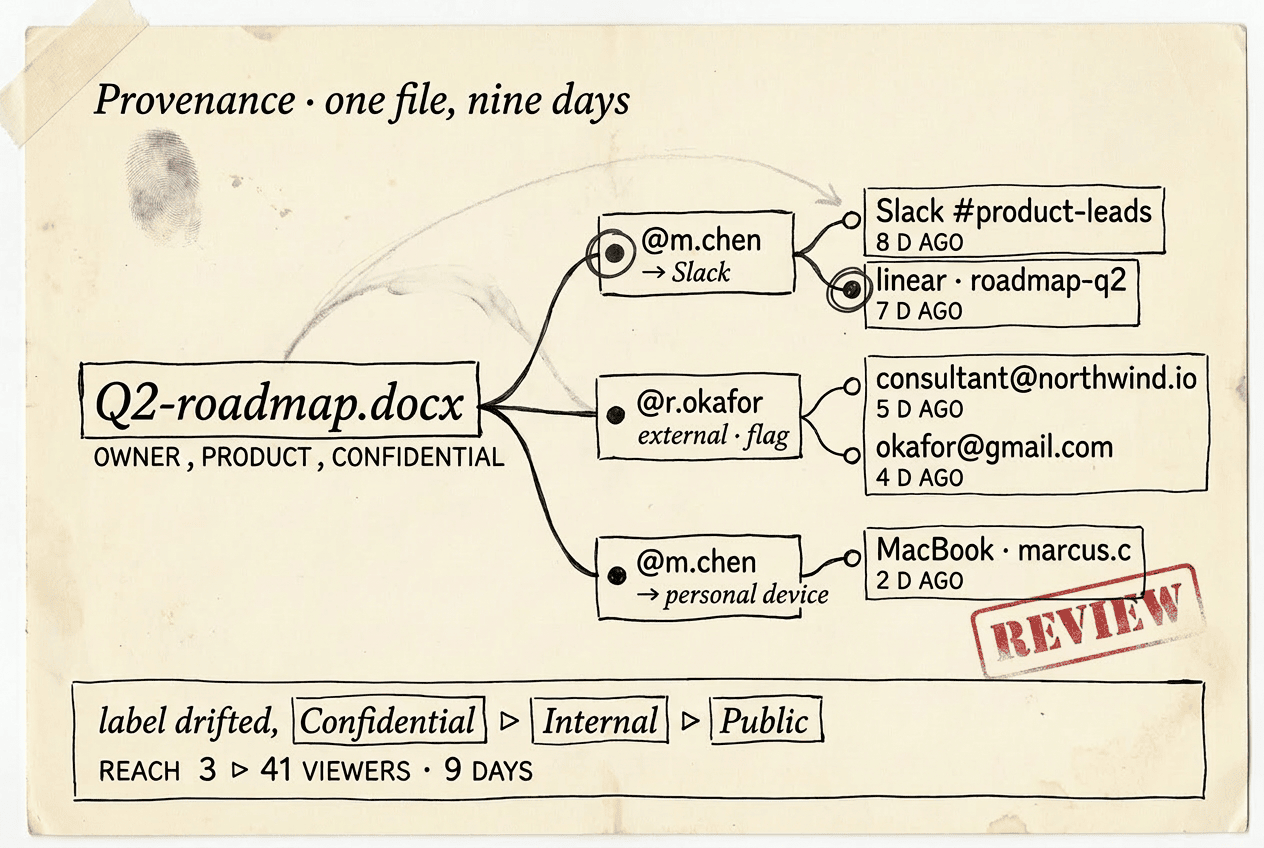
The leak, traced back to a person.
Source code into ChatGPT. Financials into Claude. Customer records into an AI extension. Anzenna captures these flows and ties each one back to employee identity, behavioral history, and surrounding context, so you see exactly what is entering AI, through which path, and when it crosses the line.
- Browser uploads and MCP activity captured as they happen, not after the fact.
- Each flow scored against the person's role, baseline, and the data's sensitivity.
- Reads metadata only, with secrets redacted before they ever reach Anzenna.
Same paste, different intent.
A prompt with sensitive data means nothing until you know who, and why.
A support agent summarizing a non-sensitive ticket in a sanctioned assistant.
A rushed employee pasting a customer list into a personal account to move faster.
A departing engineer feeding the core repo into an AI tool before the last day.
A written case, not a blocked event.
The flow surfaces as a reasoned case: the data, the path, and the person.
Protect data at the AI boundary.
Anzenna brings behavioral context to the moment sensitive data meets a generative tool, agentlessly.
- 01
See the data flows
Correlate identity, SaaS, and data signals to see where sensitive content is heading toward AI tools, sanctioned or shadow.
- 02
Weigh intent & context
Score each flow against a behavioral baseline, the person's role, and the sensitivity of the data, not a static rule.
- 03
Surface the real risk
Turn the noise into a prioritized, fully-reasoned case file: who, what data, which tool, and why it matters.
- 04
Remediate
Block, quarantine, revoke access, or notify, with a transparent audit trail and one-click action.
Rules match strings.
Anzenna reads behavior.
Traditional DLP inspects content against patterns on channels it can decrypt. Anzenna reasons over behavior, identity, and data context, so leaks into AI tools surface even when they ride ordinary encrypted traffic.
| Capability | Anzenna | Traditional DLP |
|---|---|---|
| Covers prompts & generative tools | ✓ | ✗ |
| Catches data sent to personal AI accounts | ✓ | ✗ |
| Understands intent & behavior | ✓ | ✗ |
| Output | Prioritized, reasoned case file | Blocked event or raw alert |
| False positives | 90% fewer alerts to analysts | About half of alerts are false |
| Deployment | Agentless, live in minutes | Proxies & endpoint agents |
Common questions.
Can Anzenna stop data going into ChatGPT or Claude?+
Yes. Anzenna correlates identity, SaaS, and data signals to surface sensitive content heading toward generative tools, including personal accounts, and can revoke access or notify in one click. It reasons over behavior, so it catches flows that classic DLP rules miss.
Does it replace our existing DLP?+
Either. Anzenna can consolidate DLP and UEBA, or integrate with your existing DLP to inherit its classifications while adding the behavioral context and AI coverage rule-based DLP lacks.
How does it avoid drowning us in alerts?+
Instead of firing on every pattern match, Anzenna scores each flow against behavior and data context, then assembles a prioritized case file. In production that means roughly 90% fewer alerts surface to analysts.
Does Anzenna read the content of prompts?+
Anzenna works from metadata and behavioral signals, with read-only access that is revocable at any time. It is SOC 2 Type II certified and Microsoft 365 security certified.
Govern AI end to end.
Close the prompt leak.
Thirty minutes. Your environment. No agents to deploy.