The front door, watched.
Identity Threat Detection Across Okta, Entra & Google
Clean anomalies with full business context, investigated automatically across Okta, Entra, Google, and every downstream SaaS.
The front door, watched.
Clean anomalies with full business context, investigated automatically across Okta, Entra, Google, and every downstream SaaS.
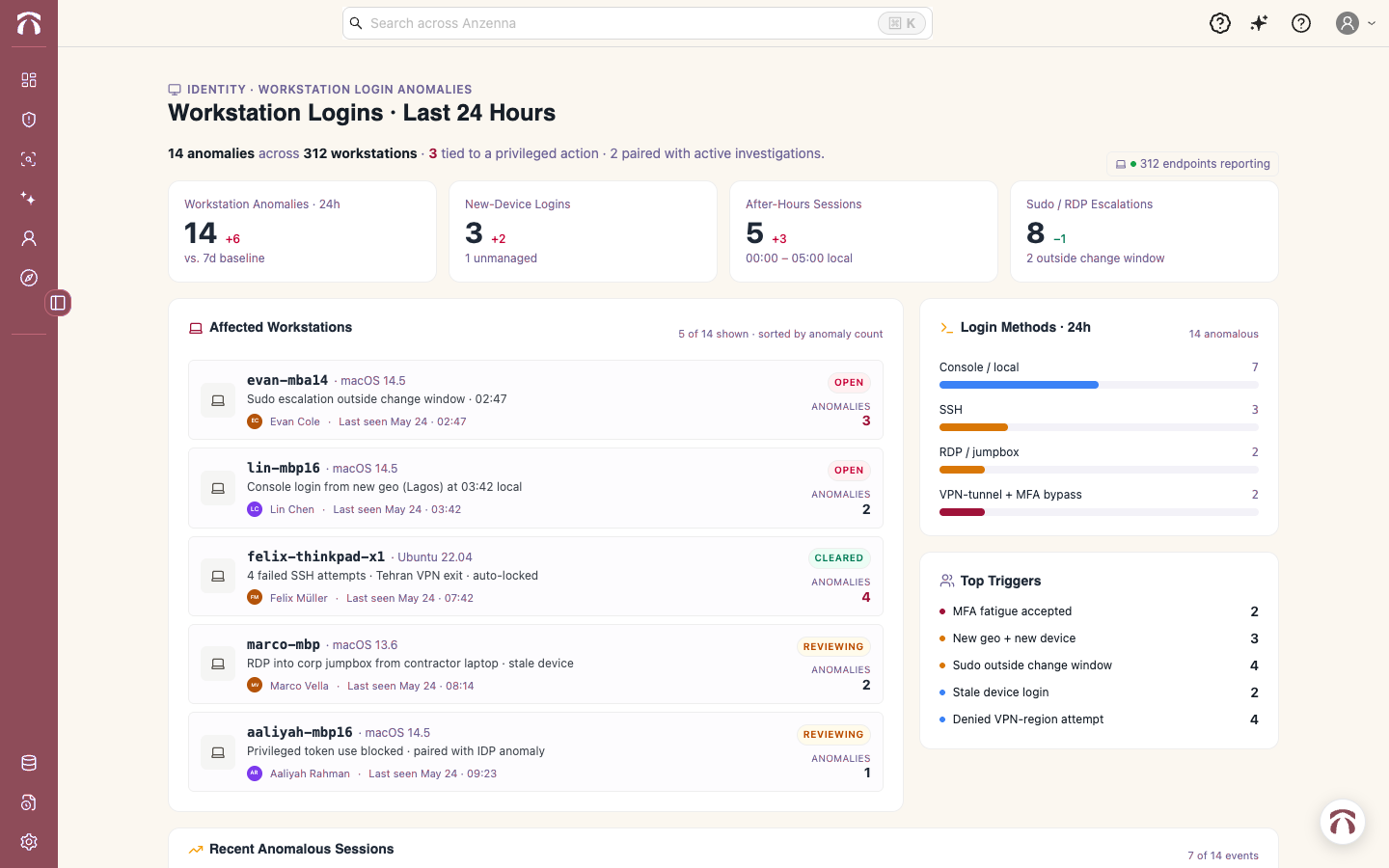
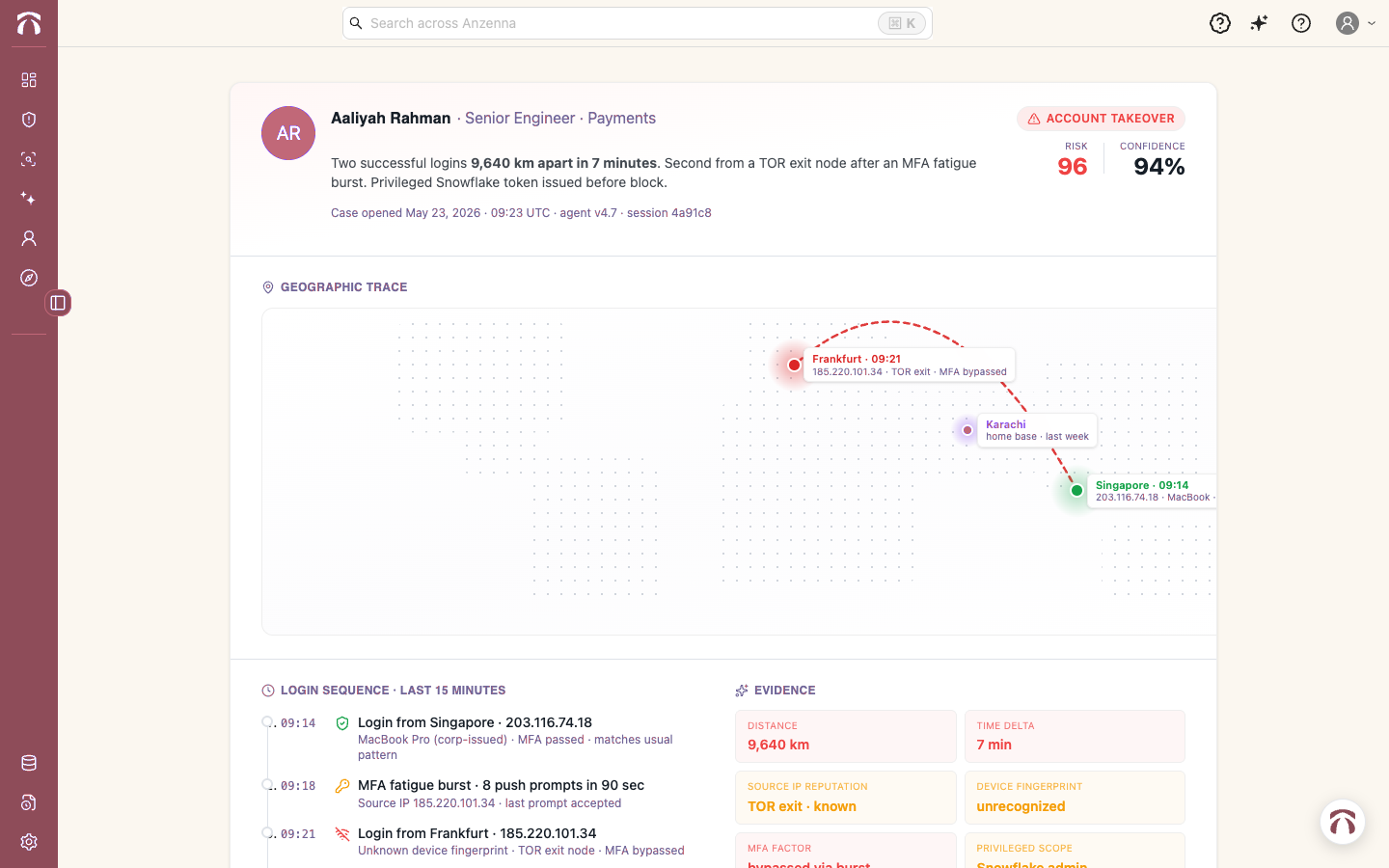
A login without context is only a threshold.
An identity provider sees one threshold, not the full passage. It has its own log format, its own anomaly engine, and its own blind spots. It does not see what happened in the browser this morning, whether the employee who just logged in from an unrecognized device gave notice yesterday, or whether those credentials appeared in a breach database last week. Until the surrounding signals are gathered in one place, the picture remains partial.

Identity events are filtered through behavioral baseline and peer context before they rise to the surface. A login from a new location means one thing for a frequent traveler, and another for someone who has never left the office. Anzenna knows the difference.

When an identity signal warrants attention, Anzenna assembles the full picture automatically: login history, downstream SaaS activity, endpoint behavior, and HR context. Role, tenure, department, status, and peer group are carried into every investigation. The analyst arrives at a conclusion, not a clue.

Service accounts and OAuth tokens accumulate permissions quietly. AI agents inherit credentials and scopes with no natural limit. Anzenna watches the full identity surface: the person, the token, and the agent.
3,000+ anomalous IDP logins. Anzenna surfaced two real issues.
Fifteen-minute install. Read-only by default. No agents on endpoints.
No. Anzenna is fully agentless. It connects to Okta, Microsoft Entra ID, Active Directory, Google Workspace and downstream SaaS through their APIs, so there is nothing to install on endpoints and nothing to maintain.
Okta, Microsoft Entra ID (Azure AD), Active Directory and Google Workspace, correlated with the SaaS, cloud and endpoint systems those identities touch, so a signal in one place is understood in the context of all the others.
Yes. Anzenna watches Okta sign-ins, session and privilege changes, MFA-bypass patterns and downstream access, then reasons over that behavior against a 90-day baseline to separate a real insider threat from noise, and can revoke or quarantine in one click.
Instead of firing a rule for every anomaly, Anzenna gathers the evidence around an identity, credential theft, session hijacking, unusual access, and weighs it into a single narrative with business context. That is the difference between an alert and an answer.
Anzenna delivers identity threat detection and response as one discipline inside a broader insider-risk and AI-usage-control platform, so identity threats are correlated with data, SaaS and endpoint activity rather than watched in isolation.
Thirty minutes. Your environment, not our slides.
Request a walkthrough ↗